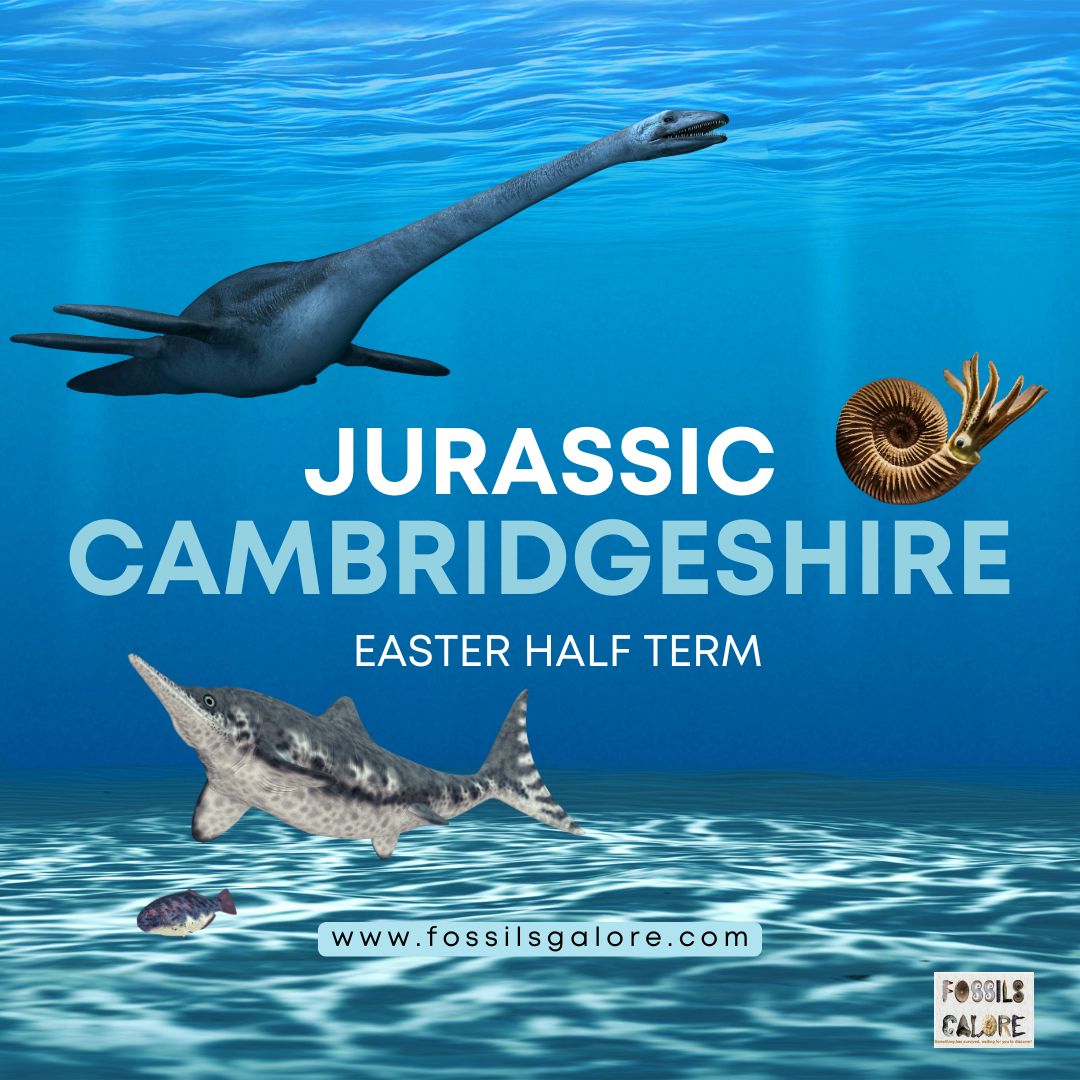
Enjoy these short Palaeo stories about the animals that once lived around Cambridgeshire.
Click on the buttons to explore more about these creatures.
Episode 1: Islands
Formation: Oxford Clay
Location: Cambridgeshire
Period: Jurassic
Epoch: Middle to Late Jurassic
Stage: Callovian-Oxfordian Boundary
Age: 164-163 million years ago
164 to 163 million years ago Cambridgeshire and the rest of the United Kingdom would have looked somewhat similar to the modern-day Bahamas and Indonesia with a diverse and thriving shallow subtropical to tropical inland sea and a chain of large islands forming what is called an archipelago. Beyond these areas were deeper water environments where ocean giants like the whale shark-sized filter feeding fish Leedsichthys and the specialised deep-diving pliosaur Simolestes spent most of their time. However, this story focuses on life on the islands that formed the Oxford Clay archipelago.
Arriving on the shores of a large island, a small herd of Cetiosauriscus stewartia, a type of sauropod or long-necked dinosaur closely related to the absurdly long necked Mamenchisaurus, stride ashore having travelled from the nearby landmass in the horizon behind them. Like many dinosaurs that inhabit the Oxford Clay archipelago Cetiosauriscus will sometimes swim to nearby islands to exploit food and drinkable water resources. Their heavy rounded feet and crescent shaped hands leave behind large disk-shaped craters in the sandy beach. Their massive necks rising out of the ocean like great leaning towers as their clubbed tails swish from side to side and salty sea water drips down their blueish grey sides and necks. Although mixed in age, most of the herd is comprised of the 15-16 metre long up to 10 tonne adults. That’s as long as a large whale shark and twice as heavy as a male African elephant!
The Cetiosauriscus herd make their way up the beach front and push into the lush subtropical forests that cover much of the islands across the archipelago. These forests are dominated by conifers, seed ferns, gingkoes and monkey puzzle relatives with a diverse understory of ferns, cycads and many more plants. As the herd makes their way down a well-used trail, likely formed by previous past visits to this island, their trampling and trumpeting startles a sleeping Sarcolestes leedsi, a species of small early ankylosaur around 3 metres long, that was resting in a shallow dug out pit nestled amongst a dense thicket of ferns that carpet a large section of forest floor. The feisty little rust-coloured ankylosaur trundles off huffing and grunting as it disappears into its nearby burrow under a trunk of an old rotting tree.
Deep in the forested interior of the island a troop of the 2.5-metre-long ornithopod Callovosaurus leedsi drink and splash about along the shores of a shallow rocky stream snaking its way through the interior from a small spring. Their bodies covered in simple dark coloured hair and quill like filaments. These little fleet footed herbivorous dinosaurs are highly sociable and often live in large groups and live a nomadic lifestyle never settling for too long in a single place. Some of the younger members of the troop play in the shallow water of the stream splashing and jumping as they chase and play with each other. The air around the stream is thick with bugs with clouds of insects occasionally disrupted by dragonflies darting through as they hunt. Some of the older members of the troop rest along the banks of the stream snoozing under the overhanging branches of a large fern.
Part way up the stream two Loricatosaurus priscus, decorated in various shades of brownish green with orangey red coloured back plates, emerge from the undergrowth and stride out into the deeper part of the stream until their bellies are partially submerged in the cool flowing waters before beginning to drink. These 5-metre-long stegosaurs are one of two stegosaurs that can be found across the archipelago. Much like their larger and more famous relative, Stegosaurus, Loricatosaurus has four enlarged spikes on the end of their tails which they use as weapons to defend themselves from predators. One of the two individuals bares numerous pathologies or healed injuries including scars from old bite marks and slashes from run ins with predators and members of its own species. Additionally, one of its four tail spikes and plate from along the middle section of the animal’s back are broken with their pointed tips having been broken off at some point in the past, likely due to failed predation attempts by carnivorous
dinosaurs. Having quenched their thirst, the small stegosaurs cross the remaining width of the stream and wonder back off into the forest.
Near the mouth of an estuary in a mangrove-like environment dominated by salt-tolerant ferns, conifers, fern relatives, and a variety of salt-tolerant horsetails rests an adult Eustreptospondylus oxoniensis sleeping under the shade of a large monkey puzzle tree. Its near blackish grey body decorated with streaks of white and crimson red rise and fall with each deep slow breath. This large and powerful predator is a type of megalosaur and at 6 metres long and a weight in excess of 600kg (that’s heavier than a Polar bear!) it is among the top predators found across the islands of the archipelago. Lying next to it sits a partially eaten carcass of its most recent kill, an adult Callovosaurus measuring 2.5 metres long. Flies infest the carcass as the remains of the herbivore begin to rot in the heat of the mid-day. Eustreptospondylus, although originally found in Oxfordshire, likely frequently swam between the islands of the Oxford Clay archipelago searching for food and freshwater filling a similar lifestyle to the modern-day Komodo dragon in Indonesia. It’s likely these ferocious predators were a frequent sight along the shores and beaches of the archipelago after a storm looking for marine life stranded on the beaches or trapped in rock pools which they can snack on.
A small young rhamphorhynchid pterosaur cautiously approaches the carcass as the Eustreptospondylus sleeps and begins to feed grabbing and pulling at the meat tearing small pieces of flesh from the carcass. However, its feeding is soon interrupted by the trumpeting bellows and crashing of the Cetiosauriscus herd from earlier moving through the forest behind the sleeping Eustreptospondylus who jerks awake and begins to look around. Spooked the young rhamphorhynchid takes to the sky and flies down towards the estuary flying over a small herd of Lexovisaurus durobrivensis feeding on a grove of fruiting cycads. Their bodies sporting a lighter forest green with cream-coloured spots, stripes and underbellies while their back plates show off bright yellows and oranges.
Lexovisaurus is the other stegosaur found across the archipelago and at 6 metres long and weighing over 2 tonnes it is the larger of the two and heavier than a Rhino!! Much like its relatives Loricatosaurus and Stegosaurus, Lexovisaurus has a back covered in thin ornamental bony plates and a tail ending in four enlarged tail spikes which they use as weapons. To most animals
the brightly coloured reddish orange fruits of cycads are highly poisonous but to dinosaurs like stegosaurs they are a nutrient rich food resource. This herd of Lexovisaurus has gathered here to exploit this resource and will help spread cycads across the archipelago through pooping out their undigested seeds.
As the herd of Lexovisaurus continues to feed one individual on the perimeter of the grove looks out over the estuary whilst munching on a cycad fruit as a 3 metre pliosaur briefly breaks the surface to breath before submerging once more. This pliosaur, a type of short necked plesiosaur, is called Pachycostasaurus dawni. Unlike the other pliosaurs of the Oxford Clay Pachycostasaurus spends much of its time frequenting the various river mouths, estuaries, swamps, and coastlines of the archipelago. Its rotund body and dense bones are adaptations to prevent unwanted rolling in strong currents and waves whilst patrolling the coastlines and river systems of the archipelago. Being able to easily traverse the invisible boundary between freshwater and saltwater allows this animal to exploit a wider range of prey than its contemporaries hunting both freshwater and marine animals. Individual Pachycostasaurus may occupy many miles of coastline within a given territory visiting numerous river systems and islands over the course of a day. This individual is on its way back out to sea likely heading to another estuary along the archipelago or perhaps a nearby patch reef to hunt.
This unfortunately brings a close to this story, but in our next adventure we will be diving beneath the waves to witness the amazing marine world of the Oxford Clay.
Episode 2: Seas
Formation: Oxford Clay
Location: Cambridgeshire
Period: Jurassic
Epoch: Middle to Late Jurassic
Stage: Callovian-Oxfordian Boundary
Age: 164-163 million years ago
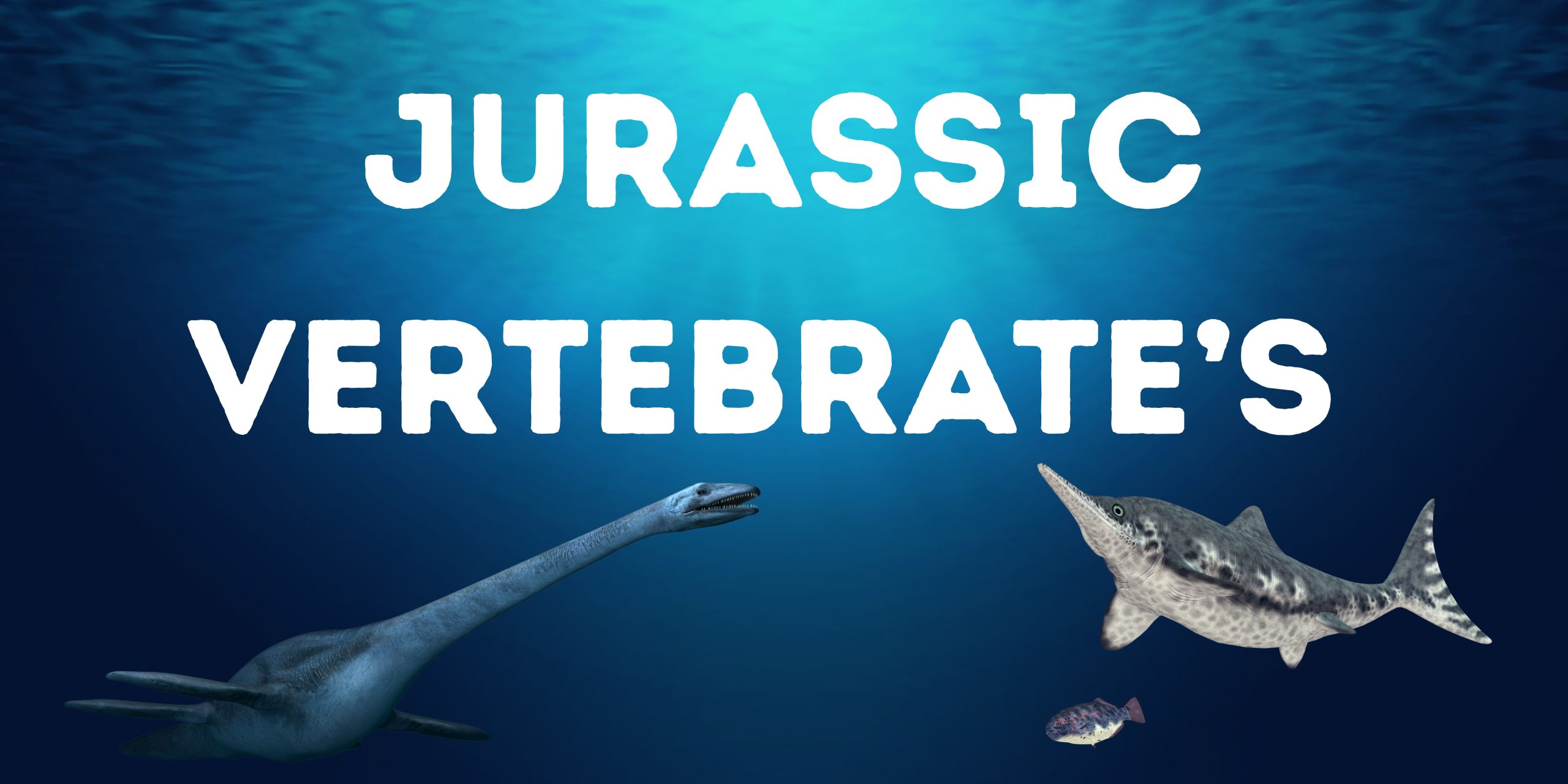
Our story starts where we left off previously at the mouth of a large estuary along the coastline of one of the many islands of an archipelago. This is Pachycostasaurus dawni, a type of short-necked plesiosaur known as a pliosaur. It is currently heading back out to sea after having spent several days upriver hunting fish and other freshwater inhabitants. At 3 metres long Pachycostasaurus was one of the smaller pliosaurs that inhabited the warm seas that covered much of what is now Cambridgeshire. However, unlike the other pliosaurs Pachycostasaurus spends much of its life living along the coastal waters of the archipelago frequenting river mouths, estuaries, coastal wetlands, and tidal deltas as well as occasionally venturing upriver into freshwater environments allowing it to exploit a wider range of potential prey. Its rotund almost barrel-like body along with is dense bones are adaptations for such a lifestyle and help to reduce rolling in strong waves and currents but comes at the cost of restricting its manoeuvrability.
As the Pachycostasaurus continues effortlessly flying through the murky waters of the estuary, utilising all four of its flippers for propulsion and steering, it swims past a large yellowish brown coloured shark rooting around on the muddy bottom. This shark is called Asteracanthus ornatissimus, a type of hybodont shark. Hybodonts are a family of ancient sharks dating back to before the dinosaurs, and at 3 metres long Asteracanthus is one of the largest hybodonts to have ever lived. This individual is searching for Gryphaea bivalves, a type of clam or oyster,
tucked away in the soupy silty muds at the bottom of the estuary. It probes at the sediment with its rounded snout using electroreception to find the bivalves in the murky conditions.
Swimming on the water around the Pachycostasaurus gradually clears as it exits the river mouth and swims out into the open ocean as the water around it gets deeper and deeper. On the seafloor below the Pachycostasaurus a large machimosaurid marine crocodile called Lemmysuchus obtusidens stalks through a large patch of crinoids and corals growing on a shelf of limestone as it hunts for fish. Despite their elongated snouts these robust crocs primarily eat turtles and small marine reptiles. Around the crocodile dance schools of various fish such as the piranha-shaped black and orange coloured Heterostrophus which peck and chop at the crinoids munching on their tough exoskeletons. Groups of silvery brown carp-like Isanichthys latifrons forage on the platform floor clouds of silt surrounding their heads as they root around searching for small molluscs, crustaceans, and worms hiding in the substrate. A few Caturus porteri hover and skulk around the platform using the crinoids and corals as cover as they hunt for small fish and invertebrates. Their trout-like bodies counter shaded with darkish blue on top and silvery grey on the underside drifting through the crinoid stalks. Small colourful triangular fish called pycnodonts flit about pecking at small invertebrates infesting the area. Unknown to the pycnodonts a well camouflaged carpet shark called Akaimia myriacuspis lay in ambush amongst the crinoids and corals waiting for one of them to swim close enough to strike. Tucked amongst a cluster of large rocks rests a 3-metre long Gracilineustes leedsi, a metriorhynchid marine crocodile. Their small dark coloured scales, rounded paddles, and shark-like tail flukes are adaptations for a fully aquatic lifestyle and make them and the rest of their kind somewhat reminiscent of the infamous but unrelated mosasaurs of the Late Cretaceous. A large group of the small ammonite Quenstedtoceras pass by as they swim over the cluster of rocks where the Gracilineustes rests.
Nearby on a slightly deeper shelf that slopes off into deeper water a group of young Ophthalmosaurus icenicus visit a pillar of rock encrusted with patches of coral, seaweed and crinoids. The little ichthyosaurs rub up against the pillar removing external parasites and barnacles covering their streamline bodies. Near the base of the pillar a pair of Kosmoceras search the crevices amongst a section of large rocks scattered across the seabed for invertebrate prey. As they forage a small school of the elongated over 1-metre-long suspension-feeding fish Martillichthys renwickae pass by with their mouths open as they swim through a
cloud of zooplankton. Not long after the Martillichthys have left two over 5 metre long cryptoclidid plesiosaurs called Tricleidus seeleyi swim up to the cluster of rocks. The plesiosaurs begin to probe around the fringes as they scoop up and ingest small stones. These stomach stones, called gastroliths, are ingested to aid in digestion of tougher prey such as bivalves and ammonites as well as helping to reduce pivoting and unwanted rolling in strong currents and at depth. However, these stones are not used as a ballast like traditionally believed as these plesiosaurs would need to ingest over 10% of their body mass in stones for them to affect their buoyancy. This would leave very little room in their stomachs for anything else.
Suddenly a dark figure surges up from the slope and rushes the group of young Ophthalmosaurus taking them by surprise as a pair of mighty jaws slam shut around one of the young ichthyosaurs. The ensuing carnage is obscured by a cloud of blood, but it is all over relatively quickly for the little ophthalmosaur. The assailant, a Liopleurodon ferox, is a large 7.5 metre long pliosaur. It is the largest and most powerful predatory marine reptile from the Oxford Clay capable of growing up to 8-10 metres long. They are the dominant apex predator of these seas. The large cutting teeth and powerful jaws of the Liopleurodon make short work of the young ichthyosaur’s flesh as the pliosaur consumes its kill before rising to the surface to catch its breath and swimming off to digest its meal in peace.
Past the shelves in deeper more open waters a major ecological event has begun to play out. A mass feeding frenzy. Several kilometres away from the coast a massive school of Leptolepis macrophthalmus, a 7.5 to 10cm long herring-like fish, have gathered near the surface as an onslaught of predators attack. Hundreds of Cylindroteuthis, a type of belemnite, and Belemnotheutis, a close relative of belemnites, pulse with colour as they dive into the school ensnaring Leptolepis in their barbed arms. Gangs of Thalattosuchus superciliosus and Suchodus durobrivensis, metriorhynchid marine crocodiles measuring over 4 metres long, snap wildly at the shimmering mass of fish as the Leptolepis dart and weave evading predators. Adult Ophthalmosaurus measuring 4 metres long torpedo through the chaos as they snatch up multiple Leptolepis. Rhamphorhynchid pterosaurs rain down from above diving into the huge school of fish. Packs of the predatory salmon-like “Hypsocormus” and elongated gar-like Aspidorhynchus euodus maraud the bait ball diving through the shimmering mass. Groups of cryptoclidid plesiosaurs comprised of the over 5 metre long Muraenosaurus leedsii and 4 metre long Cryptoclidus eurymerus attack the Leptolepis applying pressure from the underside forcing
the school closer to the surface. Joining them are several Peloneustes philarchus which swing their long narrow jaws side to side snatching up numerous Leptolepis. These 3.5-4 metre long pliosaurs are fish specialists using their narrow-elongated jaws lined with small teeth to hunt smaller slippery prey avoiding competition with its relatives. A few Simolestes vorax measuring 4.6 metres long have also joined the frenzy, ploughing through the school engulfing large numbers of fish. These large toothed deep-diving pliosaurs spend much of their time in deeper waters where they predominantly prey upon cephalopods such as belemnites and squid. The assault continues until all that is left is a cloud of slowly descending shimmering scales as the predators disperse into the deep blue.
As the sun begins to set, casting a deep orange hue over the archipelago and the surrounding seas a young teleosaur called Mycterosuchus nasutus rests atop a large crinoid raft. Crinoid rafts are created when a large number of crinoids and other benthic or bottom-dwelling animals latch onto floating logs washed out to sea during storms. Due to the relatively poor bottom water oxygen of the Oxford Clay these rafts form temporary but vital floating reef ecosystems acting as sanctuaries for fish larvae, small ammonites and much more.
A dark shadow rises from the depths as a 5 metre long Tyrannoneustes lythrodectikos metriorhynchid croc stealthily approaches the crinoid raft. Unlike the other metriorhynchids of the Oxford Clay which predominantly eat fish, Tyrannoneustes dines on larger meatier prey. As it approaches the raft it keeps low to avoid detection by the Mycterosuchus tilting its streamlined body to the left as it circles the raft slowly drawing closer and closer. Once close enough the Tyrannoneustes begins to bump the raft deliberately attempting to knock the Mycterosuchus off as the young crocodile clings on for dear life. With its first attempts unsuccessful the Tyrannoneustes ramps up the effort bumping into the raft more frequently and with more force than before. Just as the Mycterosuchus is about to fall off the raft the Tyrannoneustes suddenly stops its assault and flees as a shoal of Leedsichthys problematicus rises from the depths and surround the raft. These titanic 12-16 metre long suspension-feeding fish are the largest animals in these seas and as adults have no natural predators. This shoal has risen from the depths to feed on the abundant blooms of planktonic organisms that gather near the surface every night. Their arrival has scared the Tyrannoneustes off and inadvertently saved the life of the young Mycterosuchus.
As the warm glow of the sun begins to fade and day transitions into night the shoal of Leedsichthys swims off in search of food as our story draws to a close.
Palaeo Story Short - Written by Thomas Clarke-Williams, MSci Palaeontology & Geology